

Markets in a Minute - What Market Volatility is Telling Us About AI
Key Takeaways
- The AI buildout may be entering a more selective phase. AI infrastructure spending is projected to average 3.63% of GDP from 2025 through 2032, and the largest hyperscalers expect to borrow roughly $400 billion more next year. As the dollars climb, investors will push harder for clear returns on each new project.
- Selectivity could improve those returns. Capital is likely to flow toward projects with committed customers, reliable power and solid financing. Speculative projects may be delayed or dropped. Capacity that is already built or under construction could become more valuable.
- Policy is pulling in both directions. State restrictions could affect roughly 45% of planned data-center capacity, while federal permitting reform could speed up the grid buildout that data centers depend on.
Stocks have swung hard since Election Day. A post-election rally Wednesday gave way to a sharp selloff Thursday, then a broad rebound by Monday. Most of the damage landed on companies tied to artificial intelligence, as investors weighed what new state leaders could mean for data-center construction.
The selloff raised a more interesting question for investors: Is the artificial intelligence investment boom ending, or is one of the largest infrastructure buildouts in modern U.S. history entering a more selective phase?
What Triggered the Selloff?
Election results raised new questions about data-center development. Newly elected governors in several states have proposed slowing or pausing new construction amid concerns about electricity costs, water use and effects on local communities. Potential state and local restrictions could affect roughly 45% of planned U.S. data-center capacity, with Texas alone representing about one-quarter.
That concern arrived when some investors were already reducing exposure to crowded AI investments. Hedge funds cut gross equity exposure by roughly 7.8% in October, the largest reduction since Morgan Stanley's series began in 2016. Last Thursday during the market rout, hedge funds sold stocks they already owned about 3.5 times faster than they opened new short positions. The pattern points to investors cutting risk, which can accelerate a decline as falling prices prompt additional selling.
Technology fell 8% Thursday and semiconductors roughly 12%, compared with declines of less than 1% for Utilities and Consumer Staples. The election provided a catalyst. Crowded positioning and borrowed money helped turn it into a much larger market event.
From Building Fast to Building Selectively
Annual AI infrastructure spending is expected to average 3.63% of GDP by 2032, while the seven largest hyperscalers are expected to raise roughly $400 billion in additional debt next year alone. If these spending estimates are correct, the AI infrastructure buildout will be among the most capital intensive cycles in recent history.
Infrastructure Spending as a Percent of GDP
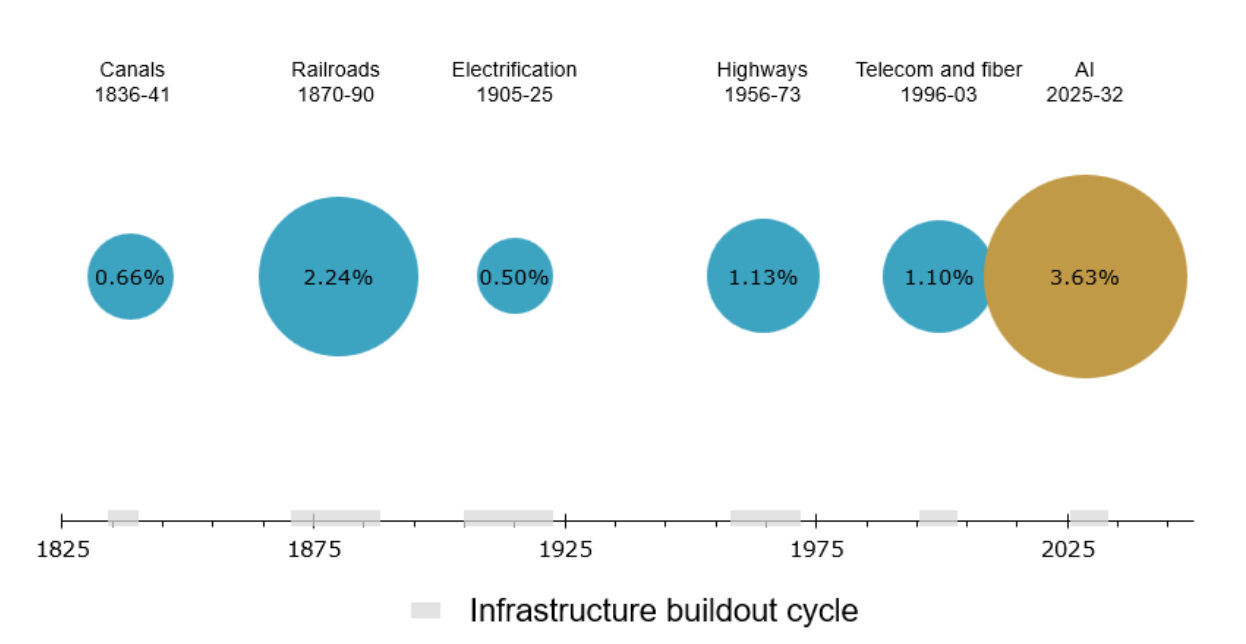
AI spending is estimated. Gray represents the period for these buildout cycles. Source: Stijn van Nieuwerburgh through Wall Street Journal, September 23, 2026.
As those commitments grow, so will investor scrutiny. Companies will increasingly have to show that new data centers can generate returns that justify the enormous amounts of capital required to build them. That could make the next phase of the AI buildout more selective, favoring projects with clear demand, reliable power and stronger expected returns.
The election added a new hurdle. While much of the 2027 construction schedule is already committed, projects planned for 2028 and beyond appear most exposed to new state restrictions.
While state policy is, in some cases, putting the brakes on data center buildout, Washington DC is pushing the other way. Federal permitting legislation is advancing in Washington and could speed federal environmental reviews, transmission projects and other infrastructure needed to supply data centers. Federal action cannot override state zoning, utility regulation or local moratoriums, so it does not remove those constraints. It could make other parts of the buildout easier.
The result may be a slower and more selective investment cycle. Projects with reliable power, committed customers, strong financing, and attractive expected returns should have an advantage. Existing and in-progress capacity become more valuable if new supply slows. With these constraints, companies are likely to become more disciplined about where they commit hundreds of billions of dollars.
What Held Steady
Thursday's decline looked broad in the major indexes, but other markets showed much less stress. As stocks declined, Treasury yields fell, boosting bond prices. The 2-year Treasury yield dropped about 10 basis points to 4.48%, while the 10-year fell roughly 5 basis points to 4.84%. High-quality bonds helped offset some of the equity decline.
Credit markets also differentiated between borrowers rather than signaling a broad funding problem. Investment-grade spreads widened only 2 basis points, compared with 16 basis points for high-yield bonds.
Corporate profits provide another useful counterweight. After several years when mega-cap technology companies dominated earnings growth, the picture is beginning to shift. Third-quarter earnings for the Magnificent Seven grew 23%, while earnings for the other 493 companies in the S&P 500 grew even faster, at 33%.
S&P 500 3rd Quarter Earnings Growth: “Magnificent 7” vs “S&P 493”
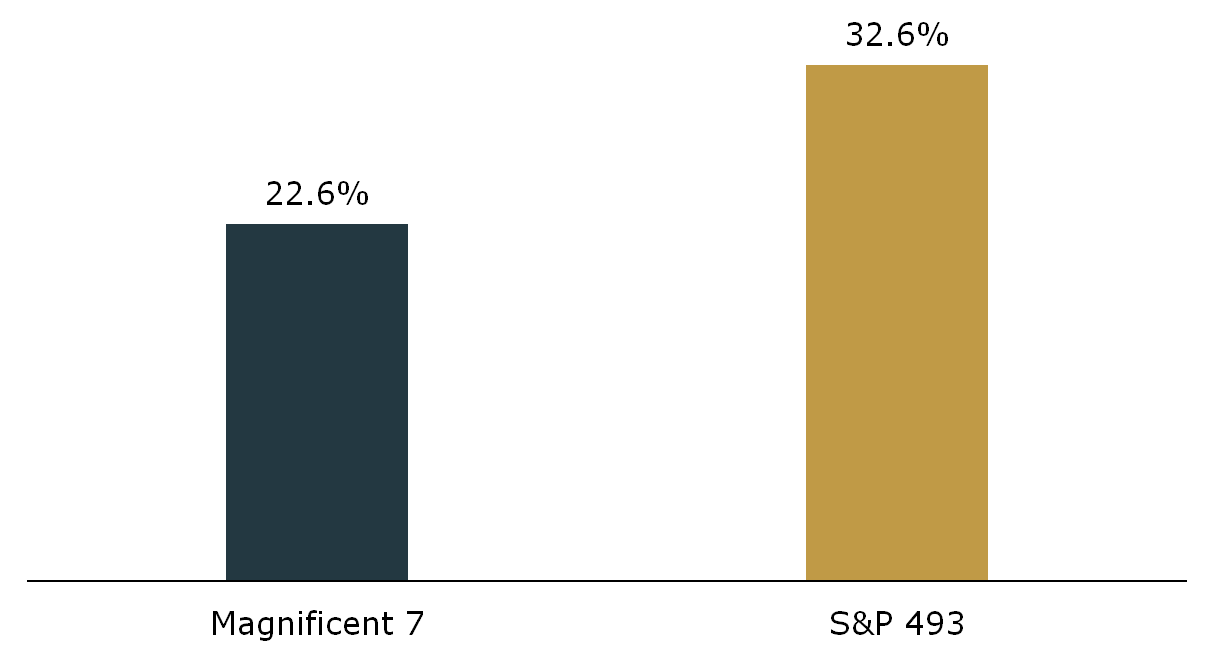
Past performance does not guarantee future results. Indexes are unmanaged and not subject to fees. It is not possible to invest directly in an index. Magnificent 7 represents Apple, Amazon, Google, Tesla, Microsoft, Nvidia, Meta. S&P 493 represents S&P 500 companies excluding the Magnificent 7. Source: Kestra Investment Management with data from FactSet. Data as of October 30, 2026.
What We're Watching
Over the next few quarters, we will watch which projects hyperscalers protect or postpone, how capital-spending plans change, and whether lenders and bond investors demand higher returns as debt funding grows.
Policy will matter too. State governments could make some projects harder to build while federal permitting reform could ease transmission and infrastructure constraints. Where projects get built may change along with how quickly they get built.
Demand for computing power remains substantial, but capital is becoming more expensive and the constraints are becoming harder to ignore. The next stage of the buildout may reward companies and projects that can demonstrate strong economics, rather than simply ambitious plans.
Last Thursday also provided a useful stress test for individual investors. Sharp market declines can reveal whether the amount of risk in a portfolio feels very different in practice than it does on paper. If last week's rout left you worried about your retirement or uncomfortable with your portfolio's losses, that reaction may be worth discussing with your financial advisor.
As always, invest wisely and live richly,
Kara
The opinions expressed in this commentary are those of the author and may not necessarily reflect those held by Kestra Advisor Services Holdings C, Inc., d/b/a Kestra Holdings, and its subsidiaries, including, but not limited to, Kestra Advisory Services, LLC, Kestra Investment Services, LLC, Kestra Private Wealth Services, and Bluespring Wealth Partners, LLC. The material is for informational purposes only. It represents an assessment of the market environment at a specific point in time and is not intended to be a forecast of future events, or a guarantee of future results. It is not guaranteed by any entity for accuracy, does not purport to be complete and is not intended to be used as a primary basis for investment decisions. It should also not be construed as advice meeting the particular investment needs of any investor. Neither the information presented nor any opinion expressed constitutes a solicitation for the purchase or sale of any security. This material was created to provide accurate and reliable information on the subjects covered but should not be regarded as a complete analysis of these subjects. It is not intended to provide specific legal, tax or other professional advice. The services of an appropriate professional should be sought regarding your individual situation. Kestra Advisor Services Holdings C, Inc., d/b/a Kestra Holdings, and its subsidiaries, including, but not limited to, Kestra Advisory Services, LLC, Kestra Investment Services, LLC, Kestra Private Wealth Services, and Bluespring Wealth Partners, LLC, do not offer tax or legal advice.